Proteins are micro machines
Forget the high-school version where proteins are "building blocks". Inside every cell of your body right now, billions of microscopic machines are walking, pumping, copying, repairing, and rotating like tiny turbines. Once you see them properly, every supplement, every fast, and every massage decision starts to make sense.
The image that changes how you see your body
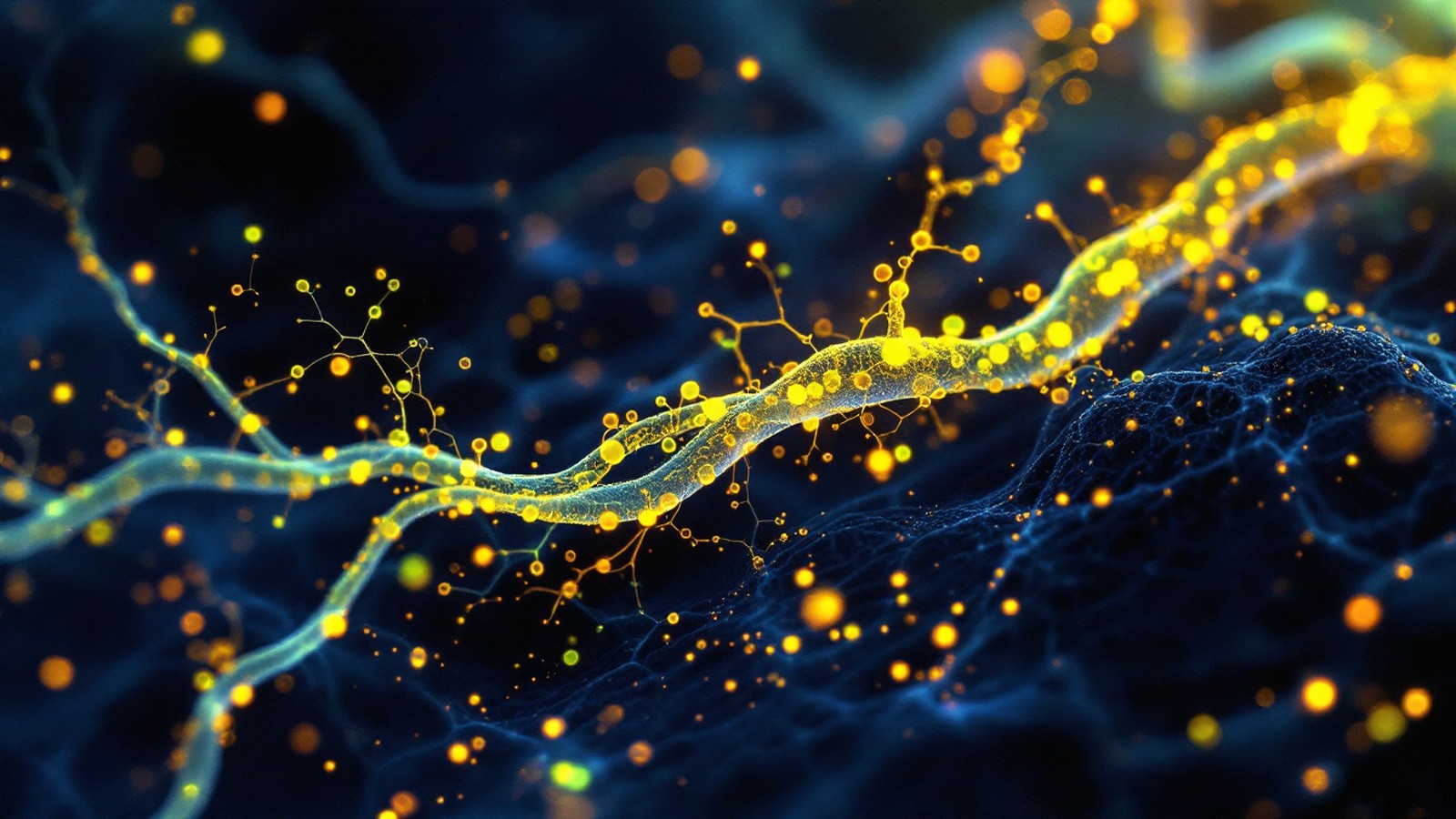
A molecular animator named Drew Berry spent years building scientifically accurate visualisations of what is actually happening inside a single human cell. When you watch his work, you see something that does not look biological at all. You see a city. You see traffic. You see machines on rails carrying cargo. You see literal turbines spinning. You see assembly lines.
That is not artistic licence. That is the cell. Every second you are reading this, your body is running roughly forty billion of those cells in parallel — each one a working factory of nano-scale machinery. And the machines doing the work are proteins.
The reason this matters: once you understand that proteins are doing things — not just sitting there being structural — every decision about how you treat your body changes.
What proteins actually do
The lazy explanation is that proteins are building blocks. That is not wrong, but it is the equivalent of describing a car as "a metal box". Technically true. Misses the point completely.
Here is what is happening inside you right now:
ATP synthase is a protein that sits in the inner membrane of every mitochondrion in your body and rotates like a literal turbine — about 100 to 150 times per second — to manufacture ATP, the energy currency every cell runs on. It is a rotary motor. Not metaphorically. Mechanically.
Kinesin is a protein that walks along microtubules inside your cells, carrying cargo from one side of the cell to the other. It has two "feet" and it actually walks, one step at a time, eight nanometres per step.
Myosin is the protein responsible for every muscle contraction you have ever made. It pulls on actin filaments using a tiny grabbing-and-releasing motion that, multiplied across billions of fibres, is how you stand up, breathe, and move your fingers.
Ion channels are proteins that act as gates — they open and close to let charged particles in or out of the cell, which is the entire basis of how nerves fire and how muscles contract on cue.
DNA polymerase is a protein that copies your DNA, base by base, at roughly 50 letters per second, with built-in error correction. The proteasome is a barrel-shaped machine that grinds up damaged proteins for recycling. Chaperones are proteins that fold other proteins into the correct shape and refold them when they get bent out of shape by heat or stress.
None of this is theoretical. All of it has been visualised at atomic resolution by cryo-electron microscopy. You are a colony of working machines.
Why this matters for the work I do
Once you accept that the body is run by molecular machinery, every decision about how to maintain it gets sharper.
Fascia is a protein matrix. Collagen and elastin are the two main proteins that make up the connective tissue I work on every day. When fascia gets dehydrated, cross-linked, or stuck, what is happening at the molecular level is that those protein fibres have lost their glide. Manual therapy is not "moving energy". It is physically rearranging a protein lattice and stimulating the cells inside it to lay down fresh, properly aligned fibres.
Supplement decisions become rational. Glutamine feeds the protein machinery that rebuilds your gut lining. Collagen peptides supply the amino acid building parts that fascia-producing cells (fibroblasts) assemble into new tissue. Creatine is not a stimulant — it is a molecule that lets your ATP-recycling machinery run faster. Once you see the machines, the supplements stop being magic and start being maintenance.
Fasting becomes obvious. Your cells contain a cleanup system called autophagy — a set of proteins that find broken components, package them up, and recycle them. The closely related mitophagy does the same for damaged mitochondria. Both are throttled while you are digesting food and ramp up significantly during fasting windows. A 14- to 16-hour fast is not punishment. It is giving the cleanup crew time to work.
Sleep is when most of the repair runs. Growth hormone pulses, glymphatic flow in the brain, and the bulk of cellular protein synthesis happen at night. Cutting sleep short does not just make you tired — it cuts the maintenance window for the entire factory.
Movement upregulates the production line. Resistance training and zone-2 cardio both signal the cell to make more mitochondria, lay down more contractile machinery, and rebuild fascia stronger than before. The signal is mechanical. The response is molecular.
The 10-year-old version
Imagine your body is a city of forty billion tiny factories. Inside each factory there are millions of small robots. Some of them spin like windmills to make energy. Some walk along little roads carrying packages. Some pull on ropes to make your muscles squeeze. Some are cleaners that look for broken stuff and take it out for recycling. Some copy the instruction manual so the factory can make new robots.
All of those tiny robots are made of the same thing — proteins. That is why eating protein matters: you are giving the factories the parts to build more workers. That is why sleeping matters: most of the building happens at night. That is why fasting helps: the cleaners get time to work properly when you are not eating. That is why moving your body matters: it tells the factory to make stronger, better robots. And that is why a good massage matters: it untangles the ropes so the workers can move freely again.
What you can do this week
Morning protocol — feed the machinery. 30g of protein within an hour of waking. Whey, eggs, or a plant protein blend. This sets the amino-acid pool high enough that your repair machines have raw material for the rest of the day. Pair it with sunlight on the eyes for ten minutes — this signals the production line that it is daytime and to start ramping up.
One supplement to consider — collagen peptides. Hydrolysed collagen (10–15g daily) supplies the specific glycine, proline, and hydroxyproline that fibroblasts need to rebuild connective tissue. Pair it with vitamin C, which is a co-factor the enzyme machinery actually requires to cross-link collagen properly. The combination is not optional — it is how the chemistry works.
California Gold CollagenUP + Vitamin C (iHerb — verified to Mauritius) →
One movement to try — slow, controlled eccentrics. Pick any compound movement (squat, push-up, deadlift). Take five seconds on the lowering phase, one second on the lift. Eccentric loading is the strongest known signal to upregulate the protein-synthesis machinery in muscle and the collagen-laying machinery in fascia. Three sets of six. Twice a week. That is enough.
Sources and further reading
Drew Berry's molecular animations are the best place to actually see what proteins do. His TED talk, "Animations of unseeable biology", is the starting point I send everyone to.
For the science itself: Molecular Biology of the Cell (Alberts et al., 7th edition, 2022) is the textbook reference for protein function and is freely searchable through NCBI Bookshelf. For ATP synthase as a rotary motor, the foundational work is Yoshida, Muneyuki and Hisabori (2001) Nature Reviews Molecular Cell Biology, and the structural work continues to be updated through cryo-EM studies in the early 2020s. For autophagy and fasting biology, Mark Mattson's review work — including the 2019 New England Journal of Medicine paper "Effects of intermittent fasting on health, aging, and disease" — is the cleanest accessible entry point.
None of this is fringe. All of it is mainstream cell biology that the wellness industry tends to skip because it is harder to sell than vibes.
Where this fits
The PPW protocols — fascia work, the anti-aging stack, the fasting handbook — are all built on the same premise: the body is a machine, machines need maintenance, and maintenance is mostly about giving the right signal at the right time. None of it is mystical. All of it is mechanical.
For an in-person assessment of your fascia, recovery pattern, and protocol fit: Book a session in Tamarin →